UtilityPerformance profile
Iseki TM215
The Iseki TM215 is a compact utility tractor designed for small farms and light work. It has a 4-wheel drive system and hydrostatic power steering, making it easy to handle in tight spaces. The tractor uses a 6-forward and 2-reverse gear transmission, which is simple to operate. Under the hood, the TM215 has a small 3-cylinder diesel engine made by Iseki. The engine is liquid-cooled and naturally aspirated, producing 15.5 horsepower at 2500 RPM. While the engine power is on the lower end compared to other tractors, it's suitable for basic tasks. The tractor's compact size, measuring 87.2 inches long, 46.9 inches wide, and 50.4 inches high, allows it to work in narrow areas. It's also quite light, weighing just 1312 pounds, which helps prevent soil compaction.
ManufacturerIsekiPower15.5 hpEngine3-cylTransUnsynchronized
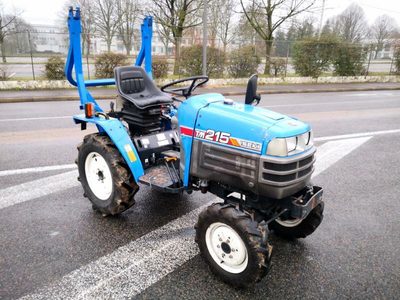
Quick specs
- Category
- Utility
- Engine Power Output
- 16hp
- Operating Weight
- 1,312 lb
- Transmission
- Unsynchronized
At a glance
How the TM215 compares
vs. Utility medianDistribution
Engine Power (hp)
Across all Utility tractors
15.5 hp · 3rd
This model
9
Median 55 hp
177
This modelUtility tractorsMediann = 5,383
The TM215 ranks at the 3rd percentile for engine power among recorded utility tractors.
Overview
About the Iseki TM215
The Iseki TM215 is a compact utility tractor designed for small farms and light work. It has a 4-wheel drive system and hydrostatic power steering, making it easy to handle in tight spaces. The tractor uses a 6-forward and 2-reverse gear transmission, which is simple to operate. Under the hood, the TM215 has a small 3-cylinder diesel engine made by Iseki. The engine is liquid-cooled and naturally aspirated, producing 15.5 horsepower at 2500 RPM. While the engine power is on the lower end compared to other tractors, it's suitable for basic tasks. The tractor's compact size, measuring 87.2 inches long, 46.9 inches wide, and 50.4 inches high, allows it to work in narrow areas. It's also quite light, weighing just 1312 pounds, which helps prevent soil compaction.
Full specifications
Every recorded spec
General
| Manufacturer | Iseki |
|---|---|
| Model | TM215 |
| Category | Utility tractor |
| Type | 4x4 MFWD 4WD |
| Operating weight | 1,312lb |
Engine
| Make | Iseki |
|---|---|
| Model | E393 |
| Power | 15.5hp |
| Cylinders | 3 |
| Displacement | 56.6ci |
| Bore | 2.91in |
| Stroke | 2.84in |
Transmission
| Type | Unsynchronized |
|---|---|
| Forward gears | 6 |
| Reverse gears | 2 |
Chassis & drive
| Chassis | 4x4 MFWD 4WD |
|---|---|
| Drive | 4WD |
| Steering | Hydrostatic power |
Hydraulics
| Type | Open center |
|---|
Dimensions
| Length | 87.2in |
|---|---|
| Width | 46.9in |
| Height | 50.4in |
| Operating weight | 1,312lb |
Capacities
| Cooling system | 1.35gal |
|---|
Head to head
TM215 vs. Utility median
How the Iseki TM215 compares to other Utility tractors
| Spec | This model | Utility median | Difference | Percentile |
|---|---|---|---|---|
| Engine Power | 15.5 hp | 55 hp | -72% | 3rd |
| Engine Displacement | 56.6 ci | 183 ci | -69% | 4th |
| Cylinders | 3 | 4 | -25% | 23rd |
| Forward Gears | 6 | 12 | -50% | 11th |
| Operating Weight | 1,312 lb | 5,303 lb | -75% | 3rd |
| Length | 87.2 in | 137 in | -36% | 4th |
| Width | 46.9 in | 66 in | -29% | 13th |
| Height | 50.4 in | 94.1 in | -46% | 3rd |
Medians and percentiles are computed from the utility tractors in our database with a recorded value for each spec (sample sizes 3,933–5,720 models).
Compare to tractors with similar specs
Commonly compared Iseki tractors
| Tractor | Engine Power | Operating Weight | Years | Compare |
|---|---|---|---|---|
| Iseki Z15 | 15.6 hp | 1,102 lb | — | Compare → |
| Iseki TF15F | 15.3 hp | 1,477 lb | — | Compare → |
| Iseki TM3160 | 15.3 hp | 1,312 lb | — | Compare → |
| Iseki TU155 | 15.3 hp | 1,378 lb | — | Compare → |
| Iseki TF153 | 15.8 hp | 1,605 lb | — | Compare → |
Commonly compared tractors with similar horsepower from other brands
| Tractor | Engine Power | Operating Weight | Years | Compare |
|---|---|---|---|---|
| Agria Hispania 7100 | 16 hp | — | — | Compare → |
| Bolens G152 | 15 hp | 1,034 lb | — | Compare → |
| Bolens G154 | 15 hp | 1,124 lb | — | Compare → |
| Bolens H1502 | 15 hp | 1,080 lb | — | Compare → |
| Bolens QS-16 | 16 hp | 849 lb | 1974–1977 | Compare → |
Explore
Iseki siblings

Explore
Similar-spec models


Gallery
Iseki TM215 photos


FAQ
Common questions
How powerful is the Iseki TM215?
The Iseki TM215 has an engine power output of 15.5 hp. It is powered by a 3-cylinder engine displacing 56.6 ci.
What hitch category is the Iseki TM215?
The Iseki TM215 uses a Category I hitch.
What is the working weight of the Iseki TM215?
The operating weight of the Iseki TM215 is approximately 1,312 lb.
What type of transmission does the Iseki TM215 have?
The Iseki TM215 uses an Unsynchronized transmission offering 6 forward gears.
What type of hydraulic system does the Iseki TM215 use?
Hydraulics on the Iseki TM215 are Open center.
What routine service does the Iseki TM215 need?
Regular maintenance for the Iseki TM215 includes checking and changing engine oil, hydraulic fluid, and filters, plus routine inspections as recommended in the owner's manual. Always follow the manufacturer's maintenance schedule for specific intervals and procedures.