Row Crop
John Deere 520
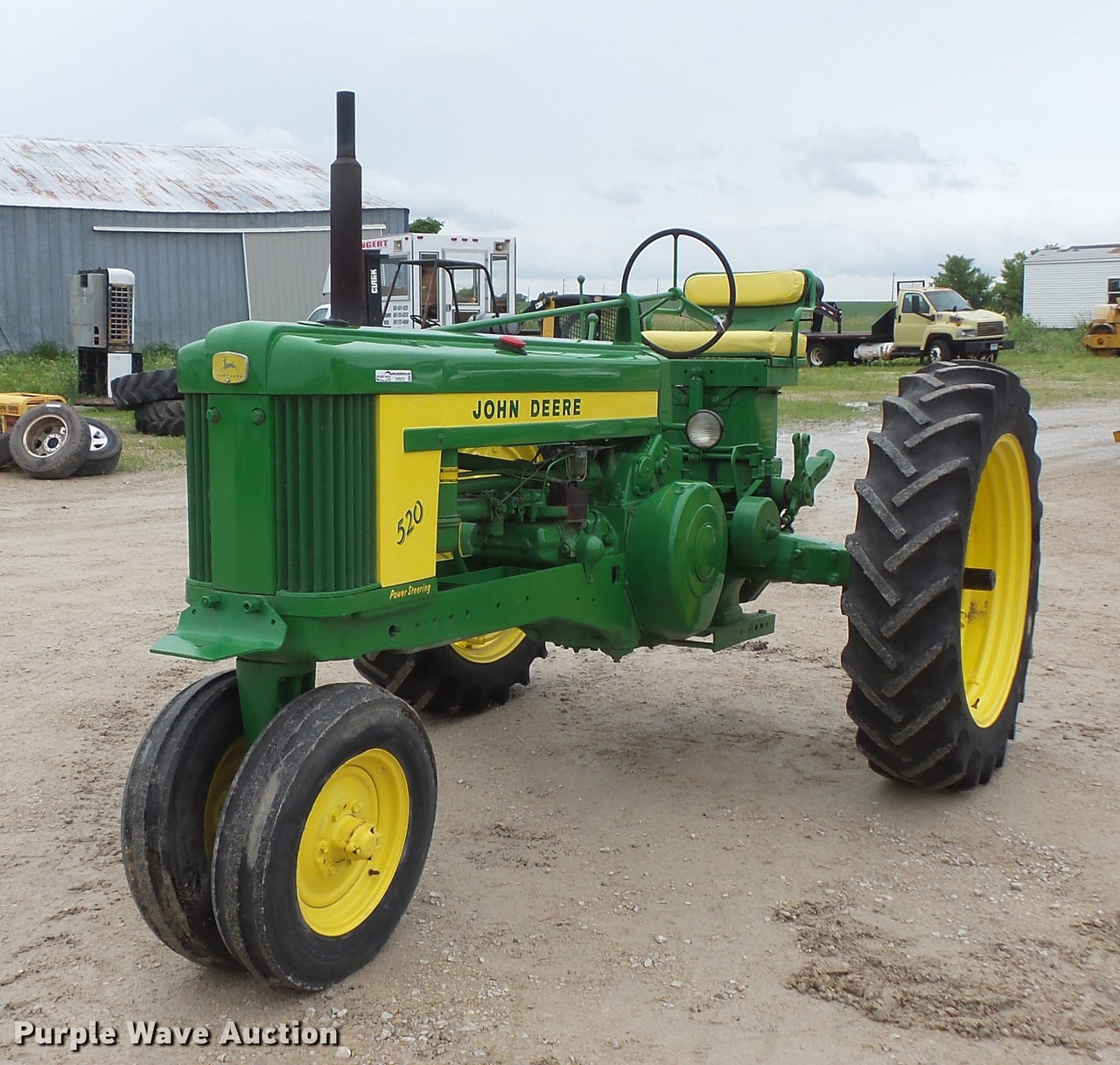
The John Deere 520 is a row crop tractor that was made from 1956 to 1958. It's a 2-wheel drive tractor with a manual steering system. This tractor has a 6-speed transmission for going forward and 1 speed for going backward. The 520 has a gasoline engine made by John Deere. It has 2 cylinders and is cooled by liquid. The engine is small compared to other tractors, but it runs at a very low speed of 1325 rpm. This tractor weighs 4960 pounds, which is on the lighter side for tractors. It's 132.7 inches long, 86.6 inches wide, and 83.1 inches tall. This tractor has some useful features for farmers. It has a three-point hitch at the back for attaching tools. The power take-off (PTO) runs at 540 rpm and works on its own. The 520 can also use a John Deere 45 loader if needed. It has an open operator station, which means no cab, and it starts with an electric starter.
ManufacturerJohn DeereEngine2-cylTransUnsynchronized gear
Quick specs
- Category
- Row Crop
- Operating Weight
- 4,960 lb
- Transmission
- Unsynchronized gear
Overview
About the John Deere 520
The John Deere 520 is a row crop tractor that was made from 1956 to 1958. It's a 2-wheel drive tractor with a manual steering system. This tractor has a 6-speed transmission for going forward and 1 speed for going backward. The 520 has a gasoline engine made by John Deere. It has 2 cylinders and is cooled by liquid. The engine is small compared to other tractors, but it runs at a very low speed of 1325 rpm. This tractor weighs 4960 pounds, which is on the lighter side for tractors. It's 132.7 inches long, 86.6 inches wide, and 83.1 inches tall. This tractor has some useful features for farmers. It has a three-point hitch at the back for attaching tools. The power take-off (PTO) runs at 540 rpm and works on its own. The 520 can also use a John Deere 45 loader if needed. It has an open operator station, which means no cab, and it starts with an electric starter.
Full specifications
Every recorded spec
General
| Manufacturer | John Deere |
|---|---|
| Model | 520 |
| Category | Row Crop tractor |
| Type | 4x2 2WD |
| Years built | 1956–1958 |
| Operating weight | 4,960lb |
Engine
| Make | John Deere |
|---|---|
| Cylinders | 2 |
| Displacement | 189.8ci |
| Bore | 4.69in |
| Stroke | 5.5in |
Transmission
| Type | Unsynchronized gear |
|---|---|
| Forward gears | 6 |
| Reverse gears | 1 |
Chassis & drive
| Chassis | 4x2 2WD |
|---|---|
| Drive | 2WD |
| Steering | Manual |
| Brakes | Differential mechanical expanding shoe |
| Cab | Open operator station |
Hydraulics
| Type | Open Center |
|---|
Power take-off
| Rear PTO | Independent |
|---|---|
| PTO speed | 540rpm |
Dimensions
| Length | 132.7in |
|---|---|
| Width | 86.6in |
| Height | 83.1in |
| Operating weight | 4,960lb |
Capacities
| Cooling system | 4.5gal |
|---|
Head to head
520 vs. Row Crop median
How the John Deere 520 compares to other Row Crop tractors
| Spec | This model | Row Crop median | Difference | Percentile |
|---|---|---|---|---|
| Engine Displacement | 190 ci | 391 ci | -51% | 6th |
| Cylinders | 2 | 6 | -67% | 1st |
| Forward Gears | 6 | 16 | -62% | 11th |
| Operating Weight | 4,960 lb | 12,307 lb | -60% | 8th |
| Length | 133 in | 180 in | -26% | 8th |
| Width | 86.6 in | 91.2 in | -5% | 40th |
| Height | 83.1 in | 114 in | -27% | 15th |
Medians and percentiles are computed from the row crop tractors in our database with a recorded value for each spec (sample sizes 806–1,417 models).
Compare to tractors with similar specs
Commonly compared John Deere tractors
| Tractor | Engine Power | Operating Weight | Years | Compare |
|---|---|---|---|---|
| John Deere 1750 | 50 hp | 6,000 lb | — | Compare → |
| John Deere 1830 | 68 hp | 5,600 lb | — | Compare → |
| John Deere 2010 | — | 5,049 lb | 1960–1965 | Compare → |
| John Deere 2020 | 59.9 hp | 5,770 lb | 1965–1971 | Compare → |
| John Deere 2120 | 68 hp | 6,615 lb | 1969–1972 | Compare → |
Commonly compared tractors with similar horsepower from other brands
| Tractor | Engine Power | Operating Weight | Years | Compare |
|---|---|---|---|---|
| Advance-Rumely 6A | — | 6,370 lb | — | Compare → |
| Advance-Rumely DoAll | — | 3,702 lb | — | Compare → |
| Advance-Rumely OilPull B 25/45 | — | 25,000 lb | — | Compare → |
| Advance-Rumely OilPull E 30/60 | — | 26,300 lb | — | Compare → |
| Advance-Rumely OilPull F 15/30 | — | 16,500 lb | — | Compare → |
Explore
John Deere siblings

Explore
Similar-spec models

Gallery
John Deere 520 photos


FAQ
Common questions
When was the John Deere 520 made?
The John Deere 520 was manufactured from 1956 to 1958.
How many cylinders does the John Deere 520 have?
The John Deere 520 runs a 2-cylinder engine with a displacement of 189.8 ci.
What is the operating weight of the John Deere 520?
In working trim, the John Deere 520 comes in at roughly 4,960 lb.
Which transmission does the John Deere 520 use?
The John Deere 520 is equipped with an Unsynchronized gear transmission with 6 forward gears.
What type of hydraulic system does the John Deere 520 use?
Hydraulics on the John Deere 520 are Open Center.
What hitch category is the John Deere 520?
The John Deere 520 uses a Category II hitch.
How do I maintain a John Deere 520?
Routine service for the John Deere 520 covers engine oil and filter changes, hydraulic and coolant level checks, air filter cleaning, and scheduled inspections. Refer to the manufacturer's maintenance schedule for exact intervals.