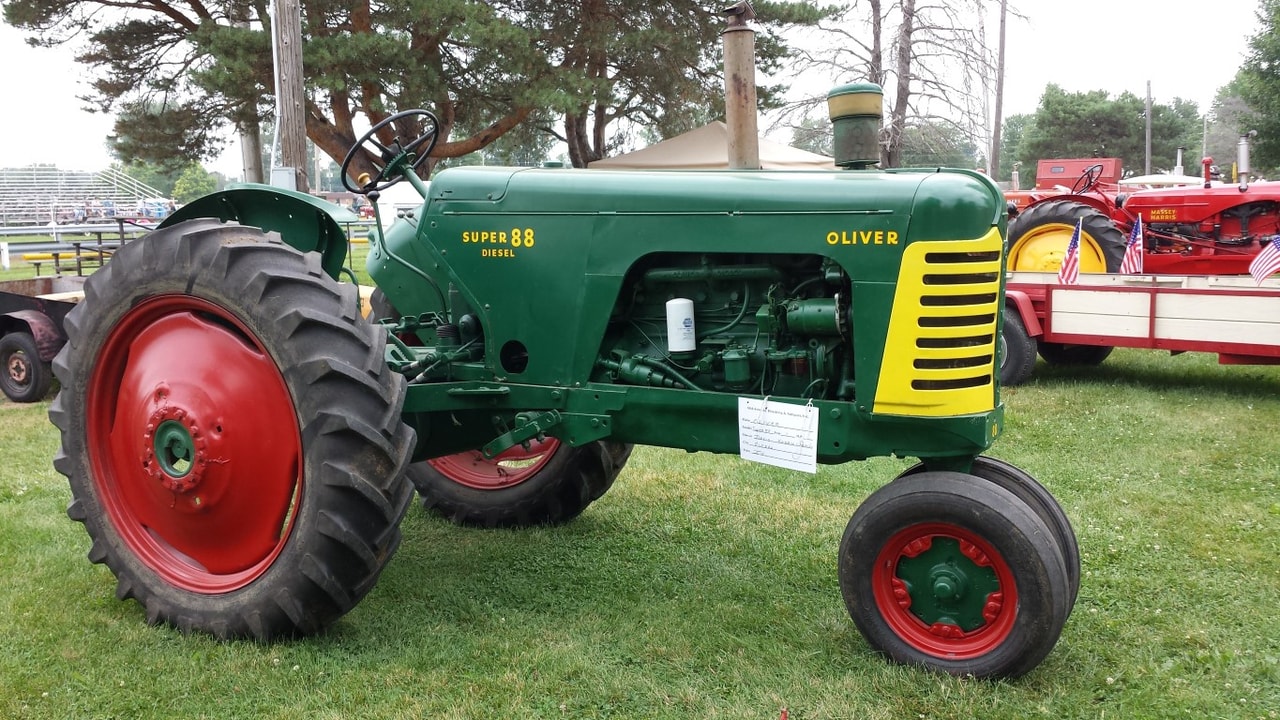
Oliver 88
The Oliver 88 is a row crop tractor made from 1947 to 1954. It's a 2-wheel drive tractor with a manual steering system. The tractor has a 6-speed gear transmission with 2 reverse gears, which gives farmers good control in the field. Under the hood, the Oliver 88 has a Waukesha-Oliver gasoline engine. It's a 6-cylinder, liquid-cooled engine with a displacement of 231 cubic inches. This engine size is below average compared to other tractors. The tractor weighs 5,004 pounds, which is also on the lighter side. It has a PTO (power take-off) that runs at 540 rpm, useful for powering other farm equipment. The Oliver 88 has an open operator station and runs on agricultural tires. It can hold 22 US gallons of fuel, allowing for long work days without frequent refueling.
Key specifications
- Category
- Row Crop
- Operating weight
- 5,004 lb
- Transmission
- Gear with dry disc clutch
Overview
About the Oliver 88
The Oliver 88 is a row crop tractor made from 1947 to 1954. It's a 2-wheel drive tractor with a manual steering system. The tractor has a 6-speed gear transmission with 2 reverse gears, which gives farmers good control in the field. Under the hood, the Oliver 88 has a Waukesha-Oliver gasoline engine. It's a 6-cylinder, liquid-cooled engine with a displacement of 231 cubic inches. This engine size is below average compared to other tractors. The tractor weighs 5,004 pounds, which is also on the lighter side. It has a PTO (power take-off) that runs at 540 rpm, useful for powering other farm equipment. The Oliver 88 has an open operator station and runs on agricultural tires. It can hold 22 US gallons of fuel, allowing for long work days without frequent refueling.
Full specifications
Recorded specifications
General
| Manufacturer | Oliver |
|---|---|
| Model | 88 |
| Category | Row Crop tractor |
| Type | 4x2 2WD |
| Years built | 1947–1954 |
| Operating weight | 5,004lb(2,270 kg) |
Engine
| Make | Waukesha-Oliver |
|---|---|
| Model | Waukesha-Oliver |
| Cylinders | 6 |
| Displacement | 231ci(3.79 L) |
| Bore | 3.5in(88.9 mm) |
| Stroke | 4.02in(102.1 mm) |
Transmission
| Type | Gear with dry disc clutch |
|---|---|
| Forward gears | 6 |
| Reverse gears | 2 |
Chassis & drive
| Chassis | 4x2 2WD |
|---|---|
| Drive | 2WD |
| Steering | Manual |
| Cab | Open |
Power take-off
| Rear PTO | Independent |
|---|---|
| PTO speed | 540rpm |
Dimensions
| Length | 141.7in(3,599 mm) |
|---|---|
| Width | 67.7in(1,720 mm) |
| Height | 68.9in(1,750 mm) |
| Operating weight | 5,004lb(2,270 kg) |
Capacities
| Cooling system | 4.5gal(17.03 L) |
|---|
Parts and manuals
Parts and manuals for the Oliver 88
Each link opens a retailer search keyed to the fields recorded for this model. Confirm fitment against the serial plate before ordering.
Filters
- Oil filter for the Waukesha-OliverAmazon
Fits the Waukesha-Oliver 6-cylinder gasoline engine listed for this model. Confirm the part number against the engine serial plate.
- Air filter for the Waukesha-OliverAmazon
Fits the Waukesha-Oliver 6-cylinder gasoline engine listed for this model. Confirm the part number against the engine serial plate.
- Fuel filter for the Waukesha-OliverAmazon
Fits the Waukesha-Oliver 6-cylinder gasoline engine listed for this model. Confirm the part number against the engine serial plate.
- Hydraulic filter for the Waukesha-OliverAmazon
Fits the Waukesha-Oliver 6-cylinder gasoline engine listed for this model. Confirm the part number against the engine serial plate.
Manuals
- Oliver 88 service and repair manualseManualOnline
Digital manuals. Built 1947 to 1954. Check the serial number range on the listing.
- Oliver 88 operator's manualAmazon
Printed and reprint manuals. Built 1947 to 1954. Check the serial number range on the listing.
- Oliver 88 service manualAmazon
Shop and repair manuals for this model.
Links in this section go to retailers. A purchase through them earns this site a commission at no extra cost to the buyer. As an Amazon Associate, Heavy Equipment Specs earns from qualifying purchases. Affiliate disclosure
Category medians
88 vs. Row Crop median
Oliver 88 compared with other Row Crop tractors
| Spec | This model | Row Crop median | Difference | Percentile |
|---|---|---|---|---|
| Engine Displacement | 231 ci | 391 ci | -41% | 13th |
| Cylinders | 6 | 6 | at median | 50th |
| Forward Gears | 6 | 16 | -62% | 11th |
| Operating Weight | 5,004 lb | 12,307 lb | -59% | 8th |
| Length | 142 in | 180 in | -21% | 13th |
| Width | 67.7 in | 91.2 in | -26% | 5th |
| Height | 68.9 in | 114 in | -39% | 6th |
Medians and percentiles are calculated from the row crop tractors in the database that have a recorded value for each specification (sample size 806–1,417 models).
Same manufacturer
Other Oliver models

Other manufacturers
Models with similar horsepower

Gallery
Oliver 88 photos


FAQ
Frequently asked questions
When was the Oliver 88 made?
The Oliver 88 was manufactured from 1947 to 1954.
What is the operating weight of the Oliver 88?
The Oliver 88 has an operating weight of about 5,004 lb.
Which transmission does the Oliver 88 use?
The Oliver 88 is equipped with a Gear with dry disc clutch transmission with 6 forward gears.
What engine configuration does the Oliver 88 use?
The Oliver 88 is equipped with a 6-cylinder engine displacing 231 ci.
How do I maintain a Oliver 88?
Routine service for the Oliver 88 covers engine oil and filter changes, hydraulic and coolant level checks, air filter cleaning, and scheduled inspections. Refer to the manufacturer's maintenance schedule for exact intervals.