Row Crop
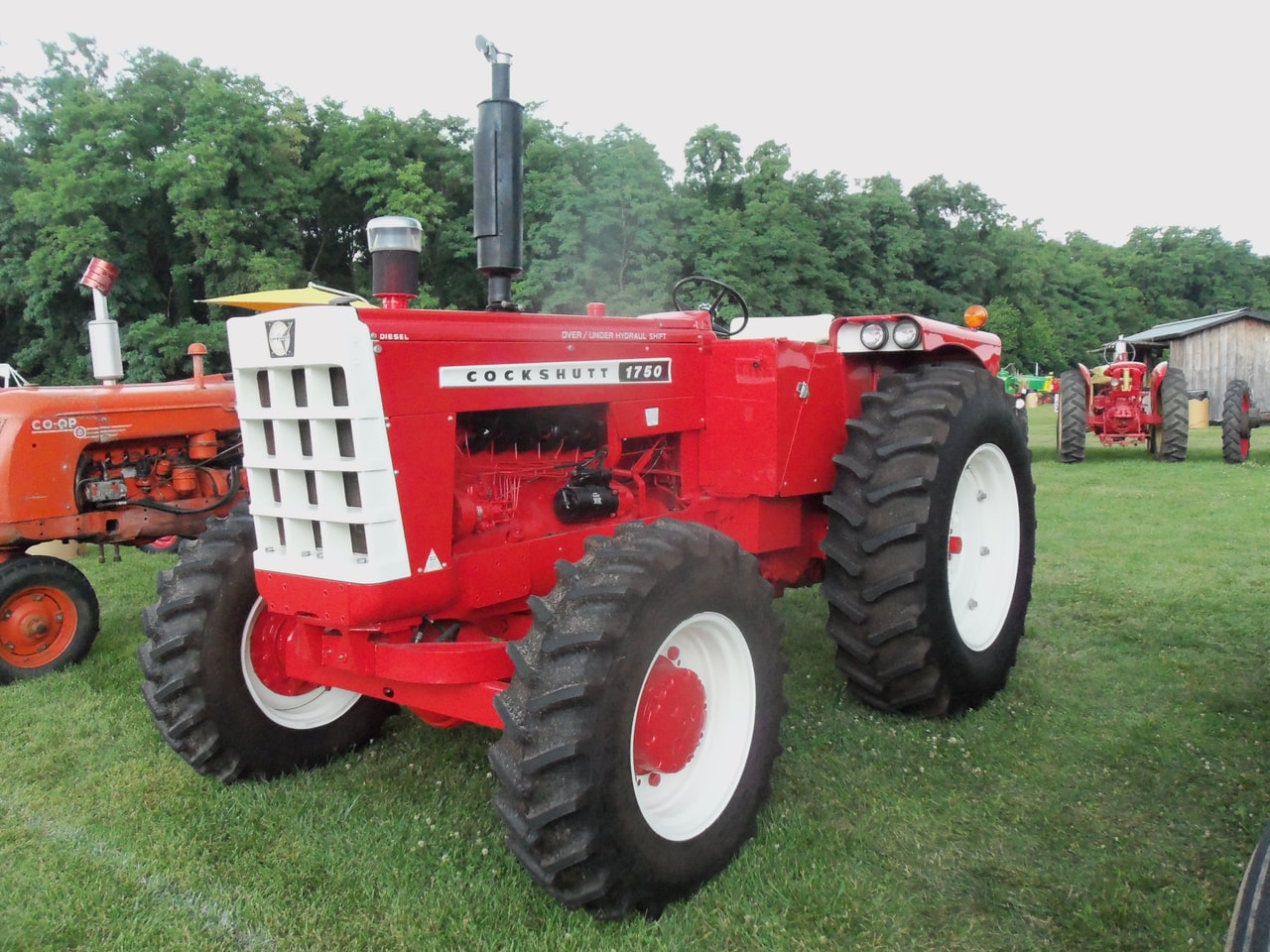
Cockshutt 1750
The Cockshutt 1750 is a row crop tractor built for farm work. It has a 2-wheel drive system and power-assisted steering, making it easy to control in the fields. The tractor uses a 6-speed transmission with 2 reverse gears, giving farmers options for different tasks. Under the hood, the Cockshutt 1750 has a Waukesha-Oliver 6-cylinder gasoline engine. This engine is air-cooled and has a displacement of 283 cubic inches, which is below average for tractors. However, it runs at a very high 2400 RPM, making it powerful for its size. The tractor weighs 9,760 pounds, which is about average for its class. It has a Category II rear hitch for attaching farm tools and an open center hydraulic system. The Cockshutt 1750 is 159.5 inches long and 80.625 inches wide, fitting well in most farm settings.
ManufacturerCockshuttEngine6-cylTransUnsynchronized gear
Quick specs
- Category
- Row Crop
- Operating Weight
- 9,760 lb
- Transmission
- Unsynchronized gear
Overview
About the Cockshutt 1750
The Cockshutt 1750 is a row crop tractor built for farm work. It has a 2-wheel drive system and power-assisted steering, making it easy to control in the fields. The tractor uses a 6-speed transmission with 2 reverse gears, giving farmers options for different tasks. Under the hood, the Cockshutt 1750 has a Waukesha-Oliver 6-cylinder gasoline engine. This engine is air-cooled and has a displacement of 283 cubic inches, which is below average for tractors. However, it runs at a very high 2400 RPM, making it powerful for its size. The tractor weighs 9,760 pounds, which is about average for its class. It has a Category II rear hitch for attaching farm tools and an open center hydraulic system. The Cockshutt 1750 is 159.5 inches long and 80.625 inches wide, fitting well in most farm settings.
Full specifications
Every recorded spec
General
| Manufacturer | Cockshutt |
|---|---|
| Model | 1750 |
| Category | Row Crop tractor |
| Type | 4x2 2WD |
| Operating weight | 9,760lb |
Engine
| Make | Waukesha-Oliver |
|---|---|
| Model | 4.6L 6-cyl gasoline |
| Cylinders | 6 |
| Displacement | 283ci |
| Bore | 3.88in |
| Stroke | 4in |
Transmission
| Type | Unsynchronized gear |
|---|---|
| Forward gears | 6 |
| Reverse gears | 2 |
Chassis & drive
| Chassis | 4x2 2WD |
|---|---|
| Drive | 2WD |
| Steering | Power assist |
Hydraulics
| Type | Open center |
|---|
Dimensions
| Length | 159.5in |
|---|---|
| Width | 80.63in |
| Operating weight | 9,760lb |
Capacities
| Cooling system | 5gal |
|---|
Head to head
1750 vs. Row Crop median
How the Cockshutt 1750 compares to other Row Crop tractors
| Spec | This model | Row Crop median | Difference | Percentile |
|---|---|---|---|---|
| Engine Displacement | 283 ci | 391 ci | -28% | 28th |
| Cylinders | 6 | 6 | at median | 50th |
| Forward Gears | 6 | 16 | -62% | 11th |
| Operating Weight | 9,760 lb | 12,307 lb | -21% | 30th |
| Length | 160 in | 180 in | -11% | 24th |
| Width | 80.6 in | 91.2 in | -12% | 25th |
Medians and percentiles are computed from the row crop tractors in our database with a recorded value for each spec (sample sizes 806–1,417 models).
Compare to tractors with similar specs
Commonly compared Cockshutt tractors
| Tractor | Engine Power | Operating Weight | Years | Compare |
|---|---|---|---|---|
| Cockshutt 1350 | — | 4,260 lb | — | Compare → |
| Cockshutt 1550 | — | 7,000 lb | — | Compare → |
| Cockshutt 1555 | — | 6,841 lb | — | Compare → |
| Cockshutt 1600 | — | 7,400 lb | — | Compare → |
| Cockshutt 1650 | — | 7,815 lb | — | Compare → |
Commonly compared tractors with similar horsepower from other brands
| Tractor | Engine Power | Operating Weight | Years | Compare |
|---|---|---|---|---|
| Advance-Rumely 6A | — | 6,370 lb | — | Compare → |
| Advance-Rumely DoAll | — | 3,702 lb | — | Compare → |
| Advance-Rumely OilPull B 25/45 | — | 25,000 lb | — | Compare → |
| Advance-Rumely OilPull E 30/60 | — | 26,300 lb | — | Compare → |
| Advance-Rumely OilPull F 15/30 | — | 16,500 lb | — | Compare → |
Explore
Cockshutt siblings


Explore
Similar-spec models

Gallery
Cockshutt 1750 photos


FAQ
Common questions
What engine configuration does the Cockshutt 1750 use?
The Cockshutt 1750 is equipped with a 6-cylinder engine displacing 283 ci.
What hydraulics does the Cockshutt 1750 have?
The Cockshutt 1750 uses an Open center hydraulic system.
What three-point hitch category does the Cockshutt 1750 use?
The Cockshutt 1750 has a Category II three-point hitch.
How much does the Cockshutt 1750 weigh?
The Cockshutt 1750 weighs about 9,760 lb in operating condition.
What transmission is in the Cockshutt 1750?
Transmission on the Cockshutt 1750 is Unsynchronized gear, with 6 forward speeds.
What maintenance does the Cockshutt 1750 require?
Like any tractor, the Cockshutt 1750 needs periodic engine oil and filter changes, hydraulic fluid checks, and regular greasing and inspection. The owner's manual lists the manufacturer's recommended service intervals.