UtilityPerformance profile
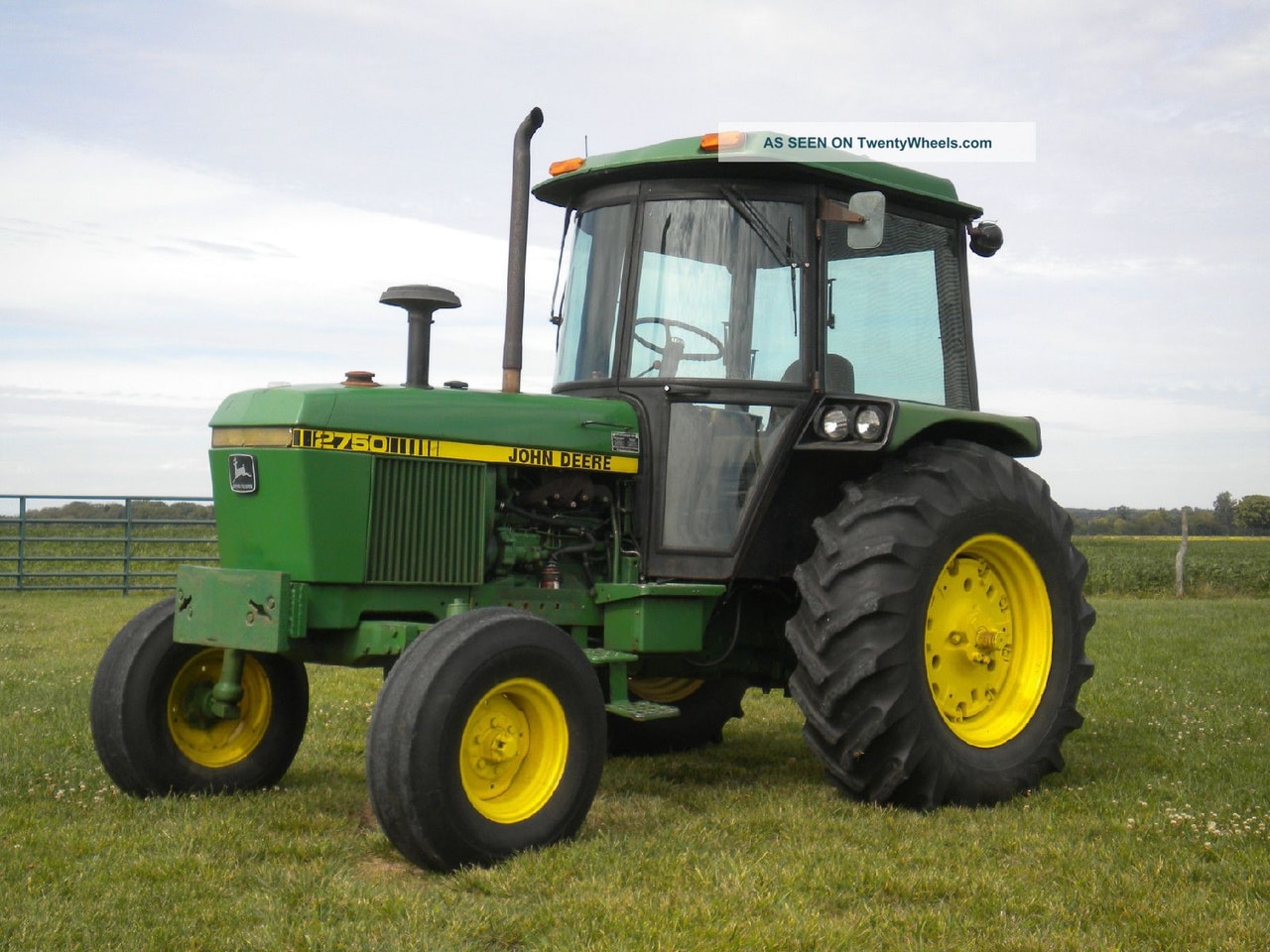
John Deere 2750
The John Deere 2750 is a utility tractor that was made from 1983 to 1986. It has a strong diesel engine with four cylinders and 75 horsepower. This engine is turbocharged, which means it can work hard without getting tired. The tractor has a special transmission that makes it easy to change gears while working. This tractor is great for lifting heavy things. It has a three-point hitch at the back that can lift up to 3,295 pounds, which is very high compared to other tractors. The 2750 also has two PTO speeds, 540 and 1000 rpm, so it can work with many different tools. Farmers can choose between an open seat with a safety frame or a closed cab with air conditioning. The tractor has good brakes and a system that helps it turn easily. It's a reliable machine that can do many jobs on the farm.
ManufacturerJohn DeerePower75 hpEngine4-cylTransPartially synchronized, Partial powershift
Quick specs
- Category
- Utility
- Engine Power Output
- 75hp
- Transmission
- Partially synchronized, Partial powershift
At a glance
How the 2750 compares
vs. Utility medianDistribution
Engine Power (hp)
Across all Utility tractors
75 hp · 68th
This model
9
Median 55 hp
177
This modelUtility tractorsMediann = 5,383
The 2750 ranks at the 68th percentile for engine power among recorded utility tractors.
Overview
About the John Deere 2750
The John Deere 2750 is a utility tractor that was made from 1983 to 1986. It has a strong diesel engine with four cylinders and 75 horsepower. This engine is turbocharged, which means it can work hard without getting tired. The tractor has a special transmission that makes it easy to change gears while working. This tractor is great for lifting heavy things. It has a three-point hitch at the back that can lift up to 3,295 pounds, which is very high compared to other tractors. The 2750 also has two PTO speeds, 540 and 1000 rpm, so it can work with many different tools. Farmers can choose between an open seat with a safety frame or a closed cab with air conditioning. The tractor has good brakes and a system that helps it turn easily. It's a reliable machine that can do many jobs on the farm.
Full specifications
Every recorded spec
General
| Manufacturer | John Deere |
|---|---|
| Model | 2750 |
| Category | Utility tractor |
| Years built | 1983–1986 |
Engine
| Make | John Deere |
|---|---|
| Power | 75hp |
| Cylinders | 4 |
| Displacement | 239ci |
| Bore | 4.17in |
| Stroke | 4.33in |
Transmission
| Type | Partially synchronized, Partial powershift |
|---|
Chassis & drive
| Steering | Hydrostatic power |
|---|---|
| Brakes | Differential hydraulic wet disc |
| Cab | Two-post ROPS or Sound-Gard cab |
Hydraulics
| Type | Closed center |
|---|
Power take-off
| Rear PTO | Independent |
|---|---|
| PTO speed | 540rpm |
Dimensions
| Height | 102in |
|---|
Capacities
| Cooling system | 0.85gal |
|---|
Head to head
2750 vs. Utility median
How the John Deere 2750 compares to other Utility tractors
| Spec | This model | Utility median | Difference | Percentile |
|---|---|---|---|---|
| Engine Power | 75 hp | 55 hp | +36% | 68th |
| Engine Displacement | 239 ci | 183 ci | +31% | 66th |
| Cylinders | 4 | 4 | at median | 50th |
| Height | 102 in | 94.1 in | +8% | 70th |
| 3-Point Hitch Capacity | 3,295 lb | 3,197 lb | +3% | 51st |
Medians and percentiles are computed from the utility tractors in our database with a recorded value for each spec (sample sizes 1,083–5,720 models).
Compare to tractors with similar specs
Commonly compared John Deere tractors
| Tractor | Engine Power | Operating Weight | Years | Compare |
|---|---|---|---|---|
| John Deere 2130 | 75 hp | 5,980 lb | 1973–1977 | Compare → |
| John Deere 2135 | 75 hp | — | — | Compare → |
| John Deere 3300 | 75 hp | 7,672 lb | — | Compare → |
| John Deere 3310 | 75 hp | 7,550 lb | 1998–2002 | Compare → |
| John Deere 5075E (2008-2012) | 75 hp | 5,475 lb | 2008–2012 | Compare → |
Commonly compared tractors with similar horsepower from other brands
| Tractor | Engine Power | Operating Weight | Years | Compare |
|---|---|---|---|---|
| Allis Chalmers D19 | 74.2 hp | 6,650 lb | 1961–1964 | Compare → |
| Barreiros R-545 | 77 hp | 7,720 lb | — | Compare → |
| AGCO LT75 | 78.98 hp | 9,600 lb | — | Compare → |
| AGCO GT65 | 71 hp | 5,335 lb | — | Compare → |
| Agco GT65A | 71 hp | 5,864.3 lb | — | Compare → |
Explore
John Deere siblings


Explore
Similar-spec models


Gallery
John Deere 2750 photos


FAQ
Common questions
When was the John Deere 2750 made?
The John Deere 2750 was manufactured from 1983 to 1986.
What is the engine power output of the John Deere 2750?
Rated engine output for the John Deere 2750 is 75 hp, delivered by a 4-cylinder engine. The engine displaces 239 ci.
Which transmission does the John Deere 2750 use?
The John Deere 2750 is equipped with a Partially synchronized, Partial powershift transmission.
What hydraulics does the John Deere 2750 have?
The John Deere 2750 uses a Closed center hydraulic system.
What three-point hitch category does the John Deere 2750 use?
The John Deere 2750 has a Category II/I three-point hitch rated to lift 3,295 lb.
How do I maintain a John Deere 2750?
Routine service for the John Deere 2750 covers engine oil and filter changes, hydraulic and coolant level checks, air filter cleaning, and scheduled inspections. Refer to the manufacturer's maintenance schedule for exact intervals.