Row CropPerformance profile
John Deere B
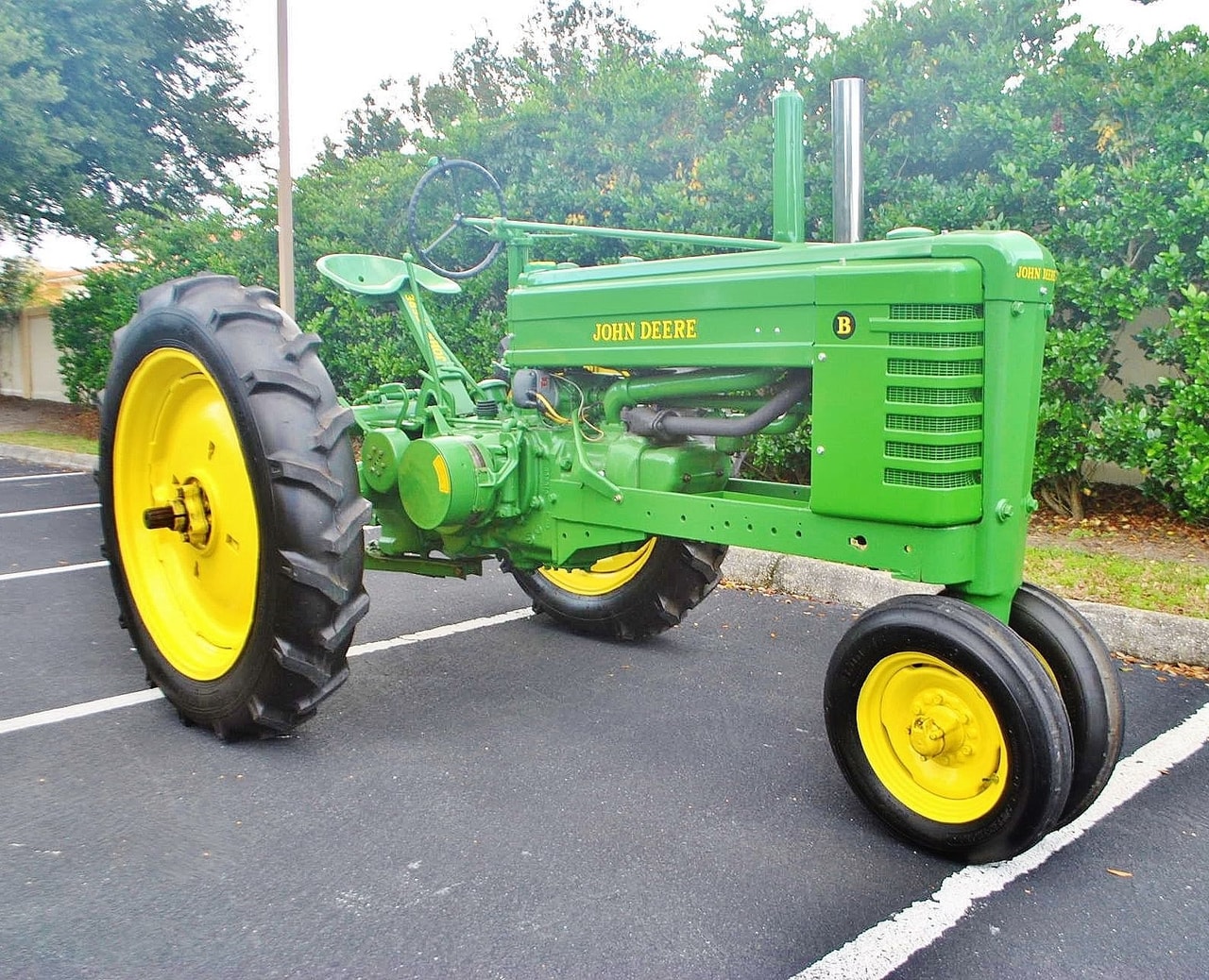
The John Deere B is a classic row crop tractor made from 1938 to 1946. It's a simple 2WD machine with a manual steering system. The tractor has a basic transmission with 3 forward gears and 1 reverse gear. It's powered by a John Deere engine that runs on all types of fuel and has 2 cylinders. This tractor is quite small compared to modern machines. It weighs 3,723 lb and is about 10 feet long. The engine is not very powerful by today's standards, with only 16.10 hp. However, it was designed for its time and could handle many farm tasks. The John Deere B has an open operator station and uses a hand-crank to start. It has a power lift hitch and a transmission-driven PTO that spins at 540 rpm. These features made it a useful tool for farmers in the mid-20th century.
ManufacturerJohn DeerePower16.1 hpEngine2-cylTransUnsynchronized gear with dry disc clutch
Quick specs
- Category
- Row Crop
- Engine Power Output
- 16hp
- Operating Weight
- 3,723 lb
- Transmission
- Unsynchronized gear with dry disc clutch
At a glance
How the B compares
vs. Row Crop medianDistribution
Engine Power (hp)
Across all Row Crop tractors
16.1 hp · 1st
This model
12
Median 138 hp
283
This modelRow Crop tractorsMediann = 1,206
The B ranks at the 1st percentile for engine power among recorded row crop tractors.
Overview
About the John Deere B
The John Deere B is a classic row crop tractor made from 1938 to 1946. It's a simple 2WD machine with a manual steering system. The tractor has a basic transmission with 3 forward gears and 1 reverse gear. It's powered by a John Deere engine that runs on all types of fuel and has 2 cylinders. This tractor is quite small compared to modern machines. It weighs 3,723 lb and is about 10 feet long. The engine is not very powerful by today's standards, with only 16.10 hp. However, it was designed for its time and could handle many farm tasks. The John Deere B has an open operator station and uses a hand-crank to start. It has a power lift hitch and a transmission-driven PTO that spins at 540 rpm. These features made it a useful tool for farmers in the mid-20th century.
Full specifications
Every recorded spec
General
| Manufacturer | John Deere |
|---|---|
| Model | B |
| Category | Row Crop tractor |
| Type | 4x2 2WD |
| Years built | 1938–1946 |
| Operating weight | 3,723lb |
Engine
| Make | John Deere |
|---|---|
| Model | John Deere |
| Power | 16.1hp |
| Cylinders | 2 |
| Displacement | 175ci |
| Bore | 4.5in |
| Stroke | 5.5in |
Transmission
| Type | Unsynchronized gear with dry disc clutch |
|---|---|
| Forward gears | 3 |
| Reverse gears | 1 |
Chassis & drive
| Chassis | 4x2 2WD |
|---|---|
| Drive | 2WD |
| Steering | Manual |
| Brakes | Differential mechanical expanding shoe |
| Cab | Open operator station |
Power take-off
| Rear PTO | Transmission |
|---|---|
| PTO speed | 540rpm |
Dimensions
| Wheelbase | 90in |
|---|---|
| Length | 125.2in |
| Width | 83.5in |
| Height | 83in |
| Operating weight | 3,723lb |
Capacities
| Cooling system | 6.25gal |
|---|
Head to head
B vs. Row Crop median
How the John Deere B compares to other Row Crop tractors
| Spec | This model | Row Crop median | Difference | Percentile |
|---|---|---|---|---|
| Engine Power | 16.1 hp | 138 hp | -88% | 1st |
| Engine Displacement | 175 ci | 391 ci | -55% | 6th |
| Cylinders | 2 | 6 | -67% | 1st |
| Forward Gears | 3 | 16 | -81% | 1st |
| Operating Weight | 3,723 lb | 12,307 lb | -70% | 4th |
| Length | 125 in | 180 in | -30% | 4th |
| Width | 83.5 in | 91.2 in | -8% | 32nd |
| Height | 83 in | 114 in | -27% | 15th |
Medians and percentiles are computed from the row crop tractors in our database with a recorded value for each spec (sample sizes 806–1,417 models).
Compare to tractors with similar specs
Commonly compared John Deere tractors
| Tractor | Engine Power | Operating Weight | Years | Compare |
|---|---|---|---|---|
| John Deere A (1934-1938) | 18 hp | 3,781 lb | 1934–1938 | Compare → |
| John Deere A (1939-1947) | 18 hp | 4,597 lb | 1939–1947 | Compare → |
| John Deere H | 12 hp | 2,080 lb | 1938–1947 | Compare → |
| John Deere G (1937-1941) | 20.7 hp | 5,004 lb | 1937–1941 | Compare → |
| John Deere G (1942-1948) | 20.7 hp | 5,291 lb | 1942–1948 | Compare → |
Commonly compared tractors with similar horsepower from other brands
| Tractor | Engine Power | Operating Weight | Years | Compare |
|---|---|---|---|---|
| Agria Hispania 7100 | 16 hp | — | — | Compare → |
| Bolens QS-16 | 16 hp | 849 lb | 1974–1977 | Compare → |
| Allis Chalmers 616 | 16.5 hp | 1,499 lb | 1972–1973 | Compare → |
| Ariens GT17 | 17 hp | 926 lb | 1979–1987 | Compare → |
| Bolens G172 | 17 hp | 1,056 lb | — | Compare → |
Explore
John Deere siblings
Explore
Similar-spec models


Gallery
John Deere B photos


FAQ
Common questions
When was the John Deere B in production?
John Deere B production started in 1938 and ended in 1946.
How much horsepower does the John Deere B have?
The John Deere B produces 16.1 hp from its 2-cylinder engine. Engine displacement is 175 ci.
How much does the John Deere B weigh?
The John Deere B weighs about 3,723 lb in operating condition.
What transmission is in the John Deere B?
Transmission on the John Deere B is Unsynchronized gear with dry disc clutch, with 3 forward speeds.
What maintenance does the John Deere B require?
Like any tractor, the John Deere B needs periodic engine oil and filter changes, hydraulic fluid checks, and regular greasing and inspection. The owner's manual lists the manufacturer's recommended service intervals.