 Brand sibling
Standard Tread
Minneapolis-Moline G750
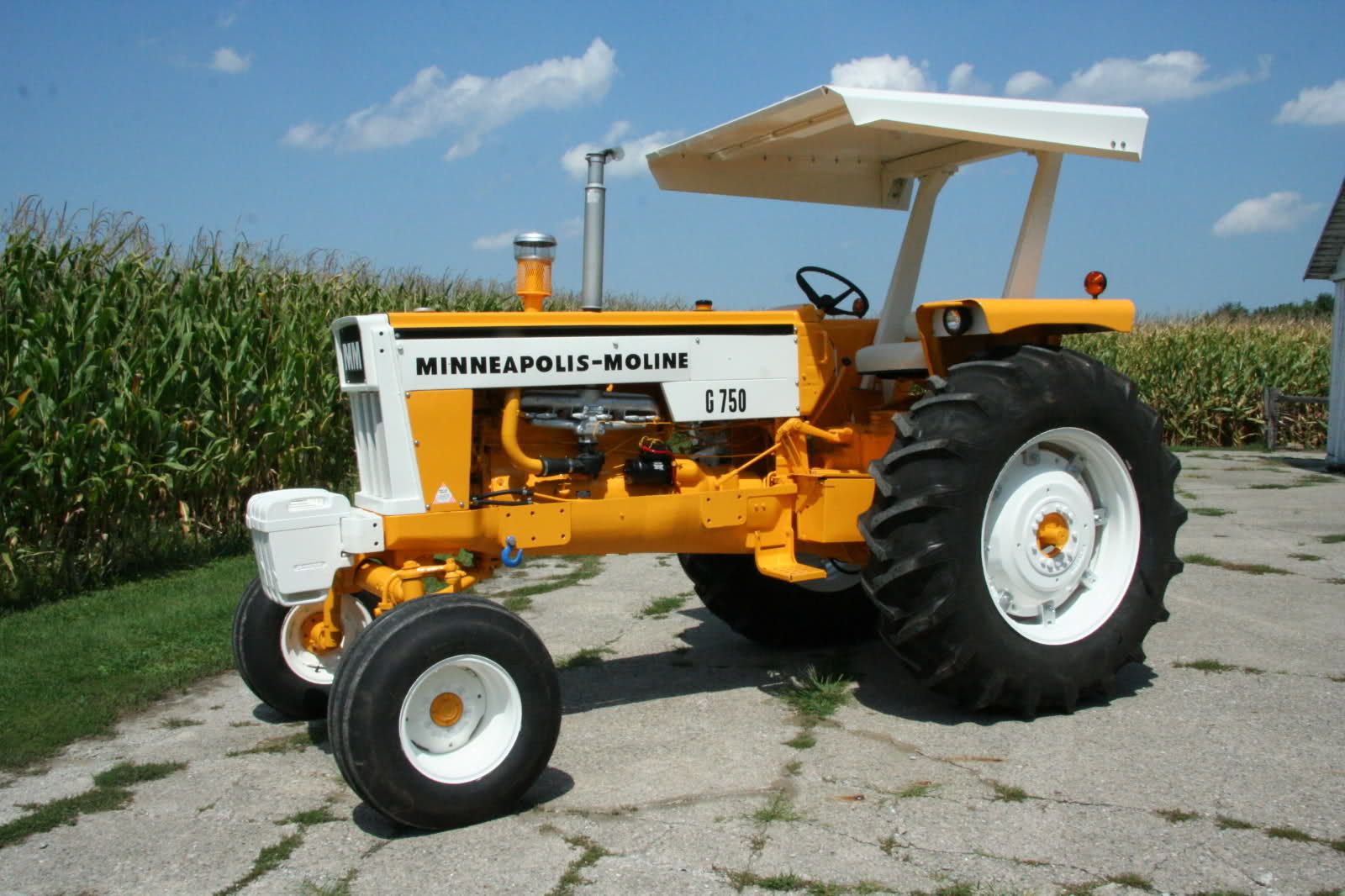
The Minneapolis-Moline G750 is a powerful 2WD tractor built for serious farm work. It features a Waukesha-Oliver 6-cylinder diesel engine that's air-cooled and naturally aspirated. The engine has a displacement of 283 cubic inches, which is quite large for a tractor of its class. It runs at 2200 RPM, providing plenty of power for tough jobs. This tractor stands out with its Hydraul-Shift transmission, offering 18 forward gears and 6 reverse gears. This gives farmers lots of options for different tasks and speeds. The G750 is a big machine, measuring 154.5 inches long and 81.5 inches wide. It weighs 7500 pounds, making it sturdy and stable. The tractor has agricultural tires front and rear, with a three-point hitch at the back for attaching various implements. It also has an open center hydraulic system and an open operator station, which is common for tractors of its era.
ManufacturerMinneapolis-MolineEngine6-cylTransPartial power shift (Hydraul-Shift)
Quick specs
- Category
- Standard Tread
- Operating Weight
- 7,500 lb
- Transmission
- Partial power shift (Hydraul-Shift)
Overview
About the Minneapolis-Moline G750
The Minneapolis-Moline G750 is a powerful 2WD tractor built for serious farm work. It features a Waukesha-Oliver 6-cylinder diesel engine that's air-cooled and naturally aspirated. The engine has a displacement of 283 cubic inches, which is quite large for a tractor of its class. It runs at 2200 RPM, providing plenty of power for tough jobs. This tractor stands out with its Hydraul-Shift transmission, offering 18 forward gears and 6 reverse gears. This gives farmers lots of options for different tasks and speeds. The G750 is a big machine, measuring 154.5 inches long and 81.5 inches wide. It weighs 7500 pounds, making it sturdy and stable. The tractor has agricultural tires front and rear, with a three-point hitch at the back for attaching various implements. It also has an open center hydraulic system and an open operator station, which is common for tractors of its era.
Full specifications
Every recorded spec
General
| Manufacturer | Minneapolis-Moline |
|---|---|
| Model | G750 |
| Category | Standard Tread tractor |
| Type | 2WD |
| Operating weight | 7,500lb |
Engine
| Make | Waukesha-Oliver |
|---|---|
| Cylinders | 6 |
| Displacement | 283ci |
| Bore | 3.88in |
| Stroke | 4in |
Transmission
| Type | Partial power shift (Hydraul-Shift) |
|---|---|
| Forward gears | 18 |
| Reverse gears | 6 |
Chassis & drive
| Drive | 2WD |
|---|---|
| Cab | Open |
Hydraulics
| Type | Open center |
|---|
Dimensions
| Length | 154.5in |
|---|---|
| Width | 81.5in |
| Operating weight | 7,500lb |
Capacities
| Cooling system | 5gal |
|---|
Head to head
G750 vs. Standard Tread median
How the Minneapolis-Moline G750 compares to other Standard Tread tractors
| Spec | This model | Standard Tread median | Difference | Percentile |
|---|---|---|---|---|
| Engine Displacement | 283 ci | 382 ci | -26% | 29th |
| Cylinders | 6 | 4 | +50% | 93rd |
| Forward Gears | 18 | 4 | +350% | 99th |
| Operating Weight | 7,500 lb | 6,834 lb | +10% | 59th |
| Length | 155 in | 137 in | +13% | 76th |
| Width | 81.5 in | 72.4 in | +13% | 71st |
Medians and percentiles are computed from the standard tread tractors in our database with a recorded value for each spec (sample sizes 233–367 models).
Compare to tractors with similar specs
Commonly compared Minneapolis-Moline tractors
| Tractor | Engine Power | Operating Weight | Years | Compare |
|---|---|---|---|---|
| Minneapolis-Moline 5 Star | — | 6,500 lb | — | Compare → |
| Minneapolis-Moline G-VI | — | 8,335 lb | — | Compare → |
| Minneapolis-Moline G704 | — | 8,700 lb | — | Compare → |
| Minneapolis-Moline G707 | — | 7,800 lb | — | Compare → |
| Minneapolis-Moline G708 | — | 8,800 lb | — | Compare → |
Commonly compared tractors with similar horsepower from other brands
| Tractor | Engine Power | Operating Weight | Years | Compare |
|---|---|---|---|---|
| Advance-Rumely 6A | — | 6,370 lb | — | Compare → |
| Advance-Rumely DoAll | — | 3,702 lb | — | Compare → |
| Advance-Rumely OilPull B 25/45 | — | 25,000 lb | — | Compare → |
| Advance-Rumely OilPull E 30/60 | — | 26,300 lb | — | Compare → |
| Advance-Rumely OilPull F 15/30 | — | 16,500 lb | — | Compare → |
Explore
Minneapolis-Moline siblings


Explore
Similar-spec models

Gallery
Minneapolis-Moline G750 photos


FAQ
Common questions
What engine configuration does the Minneapolis-Moline G750 use?
The Minneapolis-Moline G750 is equipped with a 6-cylinder engine displacing 283 ci.
What is the operating weight of the Minneapolis-Moline G750?
In working trim, the Minneapolis-Moline G750 comes in at roughly 7,500 lb.
Which transmission does the Minneapolis-Moline G750 use?
The Minneapolis-Moline G750 is equipped with a Partial power shift (Hydraul-Shift) transmission with 18 forward gears.
What hydraulics does the Minneapolis-Moline G750 have?
The Minneapolis-Moline G750 uses an Open center hydraulic system.
What three-point hitch category does the Minneapolis-Moline G750 use?
The Minneapolis-Moline G750 has a Category II/I three-point hitch.
How do I maintain a Minneapolis-Moline G750?
Routine service for the Minneapolis-Moline G750 covers engine oil and filter changes, hydraulic and coolant level checks, air filter cleaning, and scheduled inspections. Refer to the manufacturer's maintenance schedule for exact intervals.