 Brand sibling
UtilityPerformance profile
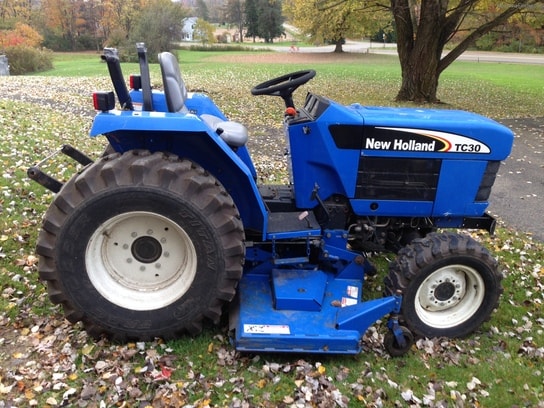
New Holland TC30
The New Holland TC30 is a compact utility tractor that was made from 2001 to 2008. It's a small but capable machine, perfect for light farm work and landscaping. The TC30 is 109 inches long, 54.3 inches wide, and 82.4 inches tall, making it easy to maneuver in tight spaces. This tractor has a Shibaura N843 diesel engine with 3 cylinders. The engine is liquid-cooled and naturally aspirated, producing 30 horsepower at 2600 rpm. While its engine displacement is below average, its rated rpm is quite high compared to other tractors. The TC30 weighs 2193 pounds, which is on the lighter side for tractors. It features power steering, wet disc brakes, and an electric starter for easy operation. The tractor comes with a Category I hitch and offers both middle and rear PTO options, running at 540 and 2000 rpm.
ManufacturerNew HollandPower30 hpEngine3-cyl
Quick specs
- Category
- Utility
- Engine Power Output
- 30hp
- Operating Weight
- 2,193 lb
At a glance
How the TC30 compares
vs. Utility medianDistribution
Engine Power (hp)
Across all Utility tractors
30 hp · 22nd
This model
9
Median 55 hp
177
This modelUtility tractorsMediann = 5,383
The TC30 ranks at the 22nd percentile for engine power among recorded utility tractors.
Overview
About the New Holland TC30
The New Holland TC30 is a compact utility tractor that was made from 2001 to 2008. It's a small but capable machine, perfect for light farm work and landscaping. The TC30 is 109 inches long, 54.3 inches wide, and 82.4 inches tall, making it easy to maneuver in tight spaces. This tractor has a Shibaura N843 diesel engine with 3 cylinders. The engine is liquid-cooled and naturally aspirated, producing 30 horsepower at 2600 rpm. While its engine displacement is below average, its rated rpm is quite high compared to other tractors. The TC30 weighs 2193 pounds, which is on the lighter side for tractors. It features power steering, wet disc brakes, and an electric starter for easy operation. The tractor comes with a Category I hitch and offers both middle and rear PTO options, running at 540 and 2000 rpm.
Full specifications
Every recorded spec
General
| Manufacturer | New Holland |
|---|---|
| Model | TC30 |
| Category | Utility tractor |
| Years built | 2001–2008 |
| Operating weight | 2,193lb |
Engine
| Make | Shibaura |
|---|---|
| Model | N843 |
| Power | 30hp |
| Cylinders | 3 |
| Displacement | 91.3ci |
| Bore | 3.31in |
| Stroke | 3.54in |
Chassis & drive
| Steering | Power |
|---|---|
| Brakes | Wet disc type |
| Cab | Two-post foldable ROPS |
Hydraulics
| Type | Open center |
|---|
Power take-off
| Rear PTO | Optional Middle / Live Rear |
|---|---|
| PTO speed | 540rpm |
Dimensions
| Length | 109in |
|---|---|
| Width | 54.3in |
| Height | 82.4in |
| Operating weight | 2,193lb |
Head to head
TC30 vs. Utility median
How the New Holland TC30 compares to other Utility tractors
| Spec | This model | Utility median | Difference | Percentile |
|---|---|---|---|---|
| Engine Power | 30 hp | 55 hp | -45% | 22nd |
| Engine Displacement | 91.3 ci | 183 ci | -50% | 17th |
| Cylinders | 3 | 4 | -25% | 23rd |
| Operating Weight | 2,193 lb | 5,303 lb | -59% | 14th |
| Length | 109 in | 137 in | -20% | 15th |
| Width | 54.3 in | 66 in | -18% | 25th |
| Height | 82.4 in | 94.1 in | -12% | 30th |
Medians and percentiles are computed from the utility tractors in our database with a recorded value for each spec (sample sizes 3,933–5,720 models).
Compare to tractors with similar specs
Commonly compared New Holland tractors
| Tractor | Engine Power | Operating Weight | Years | Compare |
|---|---|---|---|---|
| New Holland T1510 | 30 hp | 2,385 lb | 2008–2013 | Compare → |
| New Holland 1725 | 29 hp | 2,206 lb | 1997–1999 | Compare → |
| New Holland Boomer 2030 | 31 hp | 2,605 lb | — | Compare → |
| New Holland T2210 | 31 hp | 2,605 lb | — | Compare → |
| New Holland TC29 | 29 hp | 2,469 lb | 1999–2003 | Compare → |
Commonly compared tractors with similar horsepower from other brands
| Tractor | Engine Power | Operating Weight | Years | Compare |
|---|---|---|---|---|
| AGCO ST30 | 30.3 hp | 2,594 lb | — | Compare → |
| Allis Chalmers UC | 30.93 hp | 5,710 lb | — | Compare → |
| Allis Chalmers 5030 | 31 hp | 2,530 lb | 1979–1985 | Compare → |
| Allis Chalmers D12 | 31 hp | 2,800 lb | 1959–1968 | Compare → |
| Antonio Carraro Tigre 4000 | 31 hp | — | — | Compare → |
Explore
New Holland siblings

Explore
Similar-spec models

Gallery
New Holland TC30 photos


FAQ
Common questions
What years was the New Holland TC30 manufactured?
Production of the New Holland TC30 ran from 2001 through 2008.
What hydraulics does the New Holland TC30 have?
The New Holland TC30 uses an Open center hydraulic system.
What three-point hitch category does the New Holland TC30 use?
The New Holland TC30 has a Category I three-point hitch.
How powerful is the New Holland TC30?
The New Holland TC30 has an engine power output of 30 hp. It is powered by a 3-cylinder engine displacing 91.3 ci.
What is the working weight of the New Holland TC30?
The operating weight of the New Holland TC30 is approximately 2,193 lb.
What routine service does the New Holland TC30 need?
Regular maintenance for the New Holland TC30 includes checking and changing engine oil, hydraulic fluid, and filters, plus routine inspections as recommended in the owner's manual. Always follow the manufacturer's maintenance schedule for specific intervals and procedures.