IndustrialPerformance profile
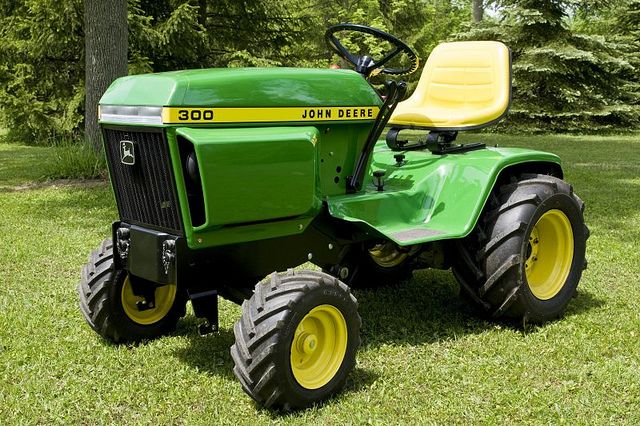
John Deere 300
The John Deere 300 is an industrial tractor that was made from 1965 to 1973. It has a 2WD drive system and a manual steering type. The tractor uses a constant mesh transmission with 8 forward gears and 4 reverse gears, giving drivers good control over speed and power. Under the hood, the John Deere 300 has a 3-cylinder diesel engine made by John Deere. The engine is liquid-cooled and naturally aspirated, with an average displacement of 152.0 ci. It can produce 43 hp at 2500 rpm, which is a bit below average for its class. The tractor has a closed center hydraulic system and both live and transmission PTO options, with speeds of 540 and 1000 rpm. It also features an electric starter and hydraulic wet disc brakes for reliable operation. This tractor is compact, measuring 120.1 inches long, 72.4 inches wide, and 71.3 inches tall. It has a below-average operating weight of 3814 lb, making it suitable for lighter industrial tasks. The John Deere 300 has an open operator station, which was common for tractors of its time. Overall, this tractor offers a good mix of features for industrial use, with John Deere's reputation for quality behind it.
ManufacturerJohn DeerePower43 hpEngine3-cylTransConstant mesh
Quick specs
- Category
- Industrial
- Engine Power Output
- 43hp
- Operating Weight
- 3,814 lb
- Transmission
- Constant mesh
At a glance
How the 300 compares
vs. Industrial medianDistribution
Engine Displacement (ci)
Across all Industrial tractors
152 ci · 23rd
This model
37
Median 284 ci
946
This modelIndustrial tractorsMediann = 53
The 300 ranks at the 23rd percentile for engine displacement among recorded industrial tractors.
Overview
About the John Deere 300
The John Deere 300 is an industrial tractor that was made from 1965 to 1973. It has a 2WD drive system and a manual steering type. The tractor uses a constant mesh transmission with 8 forward gears and 4 reverse gears, giving drivers good control over speed and power. Under the hood, the John Deere 300 has a 3-cylinder diesel engine made by John Deere. The engine is liquid-cooled and naturally aspirated, with an average displacement of 152.0 ci. It can produce 43 hp at 2500 rpm, which is a bit below average for its class. The tractor has a closed center hydraulic system and both live and transmission PTO options, with speeds of 540 and 1000 rpm. It also features an electric starter and hydraulic wet disc brakes for reliable operation. This tractor is compact, measuring 120.1 inches long, 72.4 inches wide, and 71.3 inches tall. It has a below-average operating weight of 3814 lb, making it suitable for lighter industrial tasks. The John Deere 300 has an open operator station, which was common for tractors of its time. Overall, this tractor offers a good mix of features for industrial use, with John Deere's reputation for quality behind it.
Full specifications
Every recorded spec
General
| Manufacturer | John Deere |
|---|---|
| Model | 300 |
| Category | Industrial tractor |
| Type | 4x2 2WD |
| Years built | 1965–1973 |
| Operating weight | 3,814lb |
Engine
| Make | John Deere |
|---|---|
| Power | 43hp |
| Cylinders | 3 |
| Displacement | 152ci |
| Bore | 3.86in |
| Stroke | 4.33in |
Transmission
| Type | Constant mesh |
|---|---|
| Forward gears | 8 |
| Reverse gears | 4 |
Chassis & drive
| Chassis | 4x2 2WD |
|---|---|
| Drive | 2WD |
| Steering | Manual |
| Brakes | Hydraulic wet disc |
| Cab | Open |
Hydraulics
| Type | Closed center |
|---|
Power take-off
| Rear PTO | Live and Transmission |
|---|---|
| PTO speed | 540rpm |
Dimensions
| Length | 120.1in |
|---|---|
| Width | 72.4in |
| Height | 71.3in |
| Operating weight | 3,814lb |
Capacities
| Cooling system | 2.75gal |
|---|
Head to head
300 vs. Industrial median
How the John Deere 300 compares to other Industrial tractors
| Spec | This model | Industrial median | Difference | Percentile |
|---|---|---|---|---|
| Engine Displacement | 152 ci | 284 ci | -46% | 23rd |
| Cylinders | 3 | 4 | -25% | 21st |
| Forward Gears | 8 | 5 | +60% | 85th |
| Operating Weight | 3,814 lb | 9,127 lb | -58% | 17th |
| Length | 120 in | 125 in | -4% | 32nd |
| Width | 72.4 in | 70.5 in | +3% | 52nd |
| Height | 71.3 in | 74.9 in | -5% | 41st |
Medians and percentiles are computed from the industrial tractors in our database with a recorded value for each spec (sample sizes 38–55 models).
Compare to tractors with similar specs
Commonly compared John Deere tractors
| Tractor | Engine Power | Operating Weight | Years | Compare |
|---|---|---|---|---|
| John Deere 300B | 43 hp | 7,449 lb | 1974–1983 | Compare → |
| John Deere 1010C | 40 hp | 7,580 lb | 1960–1964 | Compare → |
| John Deere 301A | 46 hp | 4,586 lb | 1973–1981 | Compare → |
| John Deere 350 | 46 hp | 7,825 lb | 1965–1970 | Compare → |
| John Deere 401B | 66 hp | 4,451 lb | 1974–1982 | Compare → |
Commonly compared tractors with similar horsepower from other brands
| Tractor | Engine Power | Operating Weight | Years | Compare |
|---|---|---|---|---|
| Allis Chalmers 5045 | 44 hp | 3,850 lb | 1981–1983 | Compare → |
| AGCO ST45 | 44.2 hp | 4,448 lb | — | Compare → |
| Ag King AK4540 | 45 hp | 4,650 lb | — | Compare → |
| Allis Chalmers ED40 | 41 hp | 3,527 lb | — | Compare → |
| Apollo 454 | 45 hp | 4,365 lb | — | Compare → |
Explore
John Deere siblings

Explore
Similar-spec models


Gallery
John Deere 300 photos


FAQ
Common questions
What years was the John Deere 300 manufactured?
Production of the John Deere 300 ran from 1965 through 1973.
What is the working weight of the John Deere 300?
The operating weight of the John Deere 300 is approximately 3,814 lb.
What type of transmission does the John Deere 300 have?
The John Deere 300 uses a Constant mesh transmission offering 8 forward gears.
What type of hydraulic system does the John Deere 300 use?
Hydraulics on the John Deere 300 are Closed center.
How powerful is the John Deere 300?
The John Deere 300 has an engine power output of 43 hp. It is powered by a 3-cylinder engine displacing 152 ci.
What routine service does the John Deere 300 need?
Regular maintenance for the John Deere 300 includes checking and changing engine oil, hydraulic fluid, and filters, plus routine inspections as recommended in the owner's manual. Always follow the manufacturer's maintenance schedule for specific intervals and procedures.